

What is a participatory process?
In traditional environmental decision-making processes, the majority of communication involves exchanges between ‘experts’ and involves little stakeholder participation. And by ‘experts’ we mean the scientists and the policy makers. Those experts then implement the changes, and others must simply adapt to them. It’s a one-way flow of information and action which requires reaction – from top to bottom.
Lecturer to pupil. Parent to child. Policy-maker to general public.
In some cases, particularly where very technical decisions are required, this method is exactly what’s needed. But in most scenarios, we at Dialogue Matters question its effectiveness. It doesn’t create ‘buy-in’ from the people it actually affects, favours technical knowledge when in fact there are many kinds of knowledge, and can lead to anxiety, hostility and conflict.
Participatory processes work to overcome these issues by involving all relevant stakeholder groups and sharing the decision-making power. This can be done to varying degrees: from information gathering (low level participation) to full shared decision making (true participation). Participants are also carefully chosen and balanced to give a representative view of the situation.
See the diagrams below which show how involving stakeholders at different levels of influence will impact upon the participatory process, and therefore methods used at each level.
Levels of Influence

Methods at Each Level
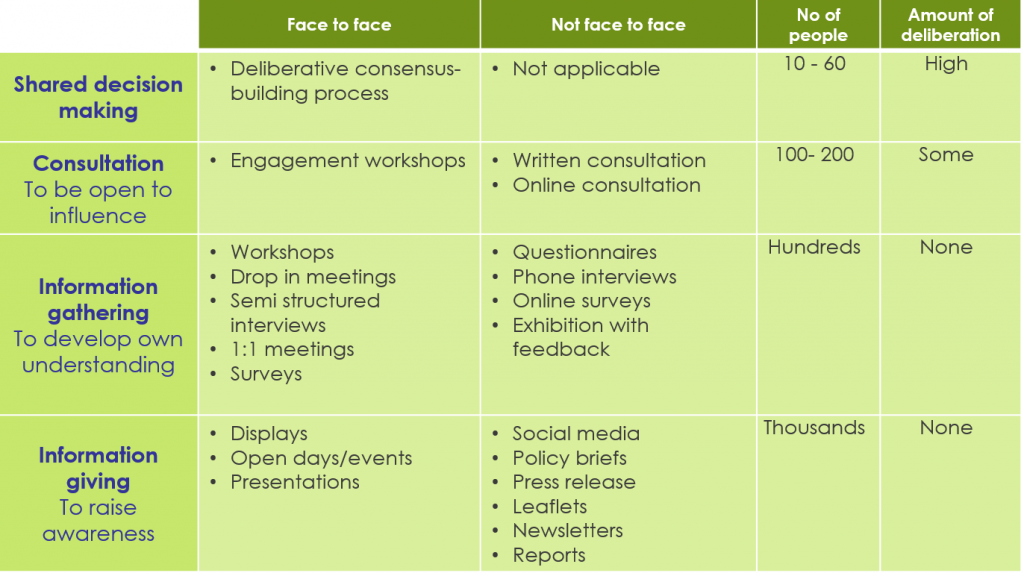
Effective, high-level stakeholder participation opens a multi-directional flow of communication between individuals with different backgrounds. This leads to a collaboration of knowledge types, broader discussions and more innovative solutions.
In these processes, tacit knowledge (experiential, inferential and conceptual understanding) is valued equally alongside technical/scientific information. The combination brings innovative, holistic suggestions to the fore, and finds win-win solutions that hit shared goals.
At Dialogue Matters we specialise in running well designed, deliberative and participatory stakeholder engagement events that do just that! The following list gives a flavour of how our workshop designs help empower stakeholders, ensuring everyone’s points are valued. We:
- Help participants talk about what matters to them using a carefully structured sequence of open questions
- Manage the room using techniques that ‘level the playing field’ so all participants feel valued and know that their knowledge is important
- Allow space for fast and slow thinkers to contemplate questions
- Select the best techniques for the tasks factor in the different ways people take in new information (auditory, visual, kinaesthetic, spatial, in groups and solo)
- Take into account group behaviour when working around complex issues and how this changes over time
- Factor in different energy levels during events
- Work out the best way to group people for a particular task (e.g. mixed interests to broaden discussion, or similar interests to deepen it)
- In high conflict situations, create a design that allows for complete anonymity
What are the benefits of taking a participatory approach?
The result of an effective participatory approach, is a well-rounded, stable decision based on all this:
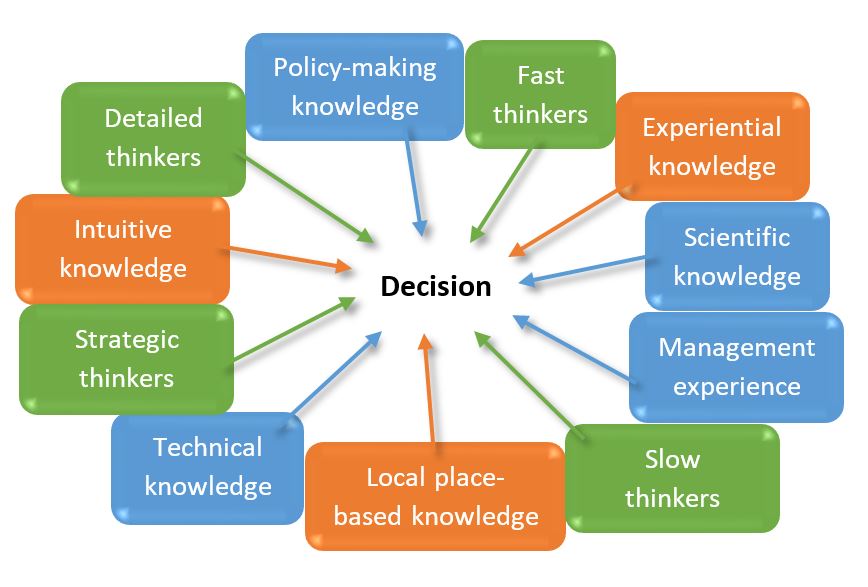
The process outcome is something much better-rounded and more likely to endure and succeed. As stakeholders have an increased level of involvement and influence in a process:
- More social capital is built between stakeholders
- More knowledge is shared and built upon
- Decisions are better informed
- Solutions are more easily integrated
- There is a real commitment to action, agreed by all stakeholders
Communicate effectively and fairly with all stakeholders through a deliberative, participatory process. Listen to those involved and build consensus around solutions that can bring about meaningful changes. Like we do!